Thursday, June 21, 2012

Sama liggey, mungi tambali


I have successfully been in village for 5 weeks now, completing what is known as Peace Corps’ 5-week challenge.  During this period, volunteers are challenged to remain at site and not spend a night at the regional house (houses owned by the Peace Corps in each region for volunteers to use to get work done or to spend a night speaking English).  And now, the real work of a volunteer begins to unfold a bit.

As I have only been here for 5 weeks, at first I spent my time merely getting to know my village.  I would spend a lot of time in my compound talking to my family, all the children who come there to play, and all the women who would stop by to speak with me or my parents.  My Wolof is still slowly improving, and people are telling me that I understand Wolof now.  (This is very generous as I still ask for a lot to be repeated or words to be explained, but I am understanding their explanations now and I can understand most of what is being said if only one person is speaking at a time.)  As time went on, I received invitations to have lunch or tea (which is drank every afternoon) at other people's compounds.  Now, in the past week, sama liggeey, mungi tambali.  (My work is starting.)  As a health/environmental education volunteer (in Senegal, these programs are synonymous-when you think about it, it makes sense since they're so interconnected), the potential for my work expands over a broad spectrum.

I have spent much time at the local high school (about a 3 km bike ride from my village) working to promote girls' education.  Thanks to the help of the students at Van Der Veer Elementary School through my mom, I will be funding 9 girls' education.  The 9 girls are in the American-equivalent of grades 6, 7, and 8 and were selected by their teachers for being incredibly bright/motivated but having a financial need that makes it difficult for them to attend school.  I have interviewed each girl (yes, in Wolof), received recommendations from their teachers, and had each complete a short essay describing their desired future and hope for girls in their community (in French).  Soon I will be going to each girl's home to speak with the family.  This process has been extremely enlightening to me.  I've learned a lot about the Senegalese school system, the difficulties these girls face in the education system in Senegal, and about life here in general.  For example, all these girls go home and cook, clean, do laundry, etc. for their family; however, they all accept it and actually don't even mention this work to me unless I ask if they do this at home.  Additionally, when I asked their biggest difficulty, one girl said that she didn't have electricity at home and her flashlight is bad, so it's sometimes hard to study.  When I asked what they plan to do with the money, all said that they would either use it to buy school supplies or give it to their parents.  One girl also said she would use some of it to buy breakfast so that she can concentrate better in school.  Finally, a few mentioned that the biggest problem facing girls in their communtiy is early marriage that causes them to drop out of school; they want to help girls be more motivated to continue.  They all said that they plan to stay in school and don't want to marry until after they graduate or after university (which they all want to attend).  After interviewing them, I couldn't help but feel incredibly lucky for the education and opportunities I received growing up.  In my house, my education came before anything else, and I was lucky to have a great school sytem.  I know some places in the US have similar conditions to here, but I realize how much stronger you have to be (especially as a girl) to succeed in the Senegalese school system compared to East Brunswick, NJ.  Here there is not the same support system at home and school to help you pass.  I even see this from the knowledge the students have.  It is incredibly disheartening to see 10-year-olds struggle to read and having difficulty sounding letters out; at that age, I was flying through books and writing (very short) reports in school.

I have also spent some time working at the health post.  This is similar to a doctor's office in the US; it is a step below the hospitals.  However, there is only one qualified doctor and only 2 or 3 nurses to care for many villages.  I spent a day assisting with vaccinating babies in a nearby village.  We traveled to the village by ambulance.  (Think big white van with an empty back, no equipment but room for someone to lie down.)  We then sat under a tree and waited for the women to come with their babies.  The nurse would administer the vaccine (polio, yellow fever, TB, or Penta), and I would record it all in a booklet for the moms and a master book for all the babies in the village.  It was a good system since then both the health post and the mothers have the information about vaccinations.  Unfortunately, the date of the vaccinations was not spread well throughout the village and only 28 arrived.  However, she will return next month so hopefully those who didn't come this time will come then.

I have been doing some traveling to other volunteers' sites to work in their gardens.  I have helped to start tree nurseries, plant vegetables, and beautify an urban space to have as a teaching garden.  My garden is also just beginning; just yesterday, I planted vegetables in a nursery that I will later transplant.  Hopefully they will grow so that I can give them to my family for meals.  I hope to also start a garden at the primary school in my village to grow vegetables for the village to eat and/or sell.  There are currently school gardens at the two high schools near me started by previous Peace Corps volunteers.  These gardens were created to supplement the World Food Program's provision of free lunches for students who come from far-away villages to school every day.  The vegetables grown would supplement the rice and other grains donated by WFP.  They need a bit of a revival though, so I hope to go to them soon.  (Due to teacher strikes this year, the school year was greatly disrupted and thus the education of students and the condition of the school gardened suffered.)

I have decided to work to bring my village more trees.  Currently, there are only neem trees in my village.  Though these trees have important medicinal properties, my villlage does not know them.  (I will soon start to teach them how to make a mosquito repellent from the leaves and other uses.)  However, there are no fruit-producing trees for consumption or sale.  Though my village does eat and sell a lot of mangos, they buy these in bulk from other villages.  Therefore, I went to speak with the Eaux et Forets branch to bring tree seedlings for transplant to my village.  My village is now planning to host a meeting to determine how many and what types of trees they want; they are all really excited to have more trees.  It is something they have wanted for awhile, but have been unsure of how to accomplish.  I am hoping that Eaux et Forets will grant the request as promised, but I am waiting to find out.

I have begun to teach one woman and a few children english.  This woman approached me saying she wanted to learn english.  She was not the first to do so, but she was the first to actually follow through with this desire.  I have worked with her 3 times so far (though she apparently came over on some of the days I was away from my village too) and is very dedicated to learning.  She has a lot of trouble retaining the information, but tries so hard.  One of the kids is picking up what I teach really fast though.  I need to develop a better system to teach her and the kids separately.  This woman is amazing though.  She is always laughing, inviting me over for lunch, and trying to help me.  The other day, when I walked into a neighboring village with her and my mom for a ceremony, she said something to me.  I thought she was asking if I could run, but she may have been saying something else.  Anyway, I then asked her if she could run, and we ended up dashing down the road together, laughing hysterically as passers-by stared at us. 

Finally, I took it upon myself to go to every compound a few days ago to record the name of every person living there.  This is the first census ever done in my village, and everyone is curious about the stats.  I learned that there are 26 compounds (2 of which contain 3 heads of the house living in one compound).  In total, there are 397 people (assuming no one forgot to mention someone, which is quite possible), twice the number my village had estimated lived there.  As I went to every compound, I was shocked to realize that I didn't recognize everyone; apparently, I see and talk to the same group of people all the time.  But everyone asked me to stay to talk and drink tea, so I will be going back to every compound to spend more time with them.

So these projects are all only just beginning.  In reality, nothing is really accomplished during the first 3 months until after our training in August, but it is nice to have some small projects to work on now.  I feel so much better when I am busy and working toward something.  I also am beginning to formulate some ideas for bigger projects down the road.  It is just the beginning now, but I know soon I will be jam-packed with work as I try to do as much as I can to help my village.

Friday, June 8, 2012

Begge naa tella teddi.


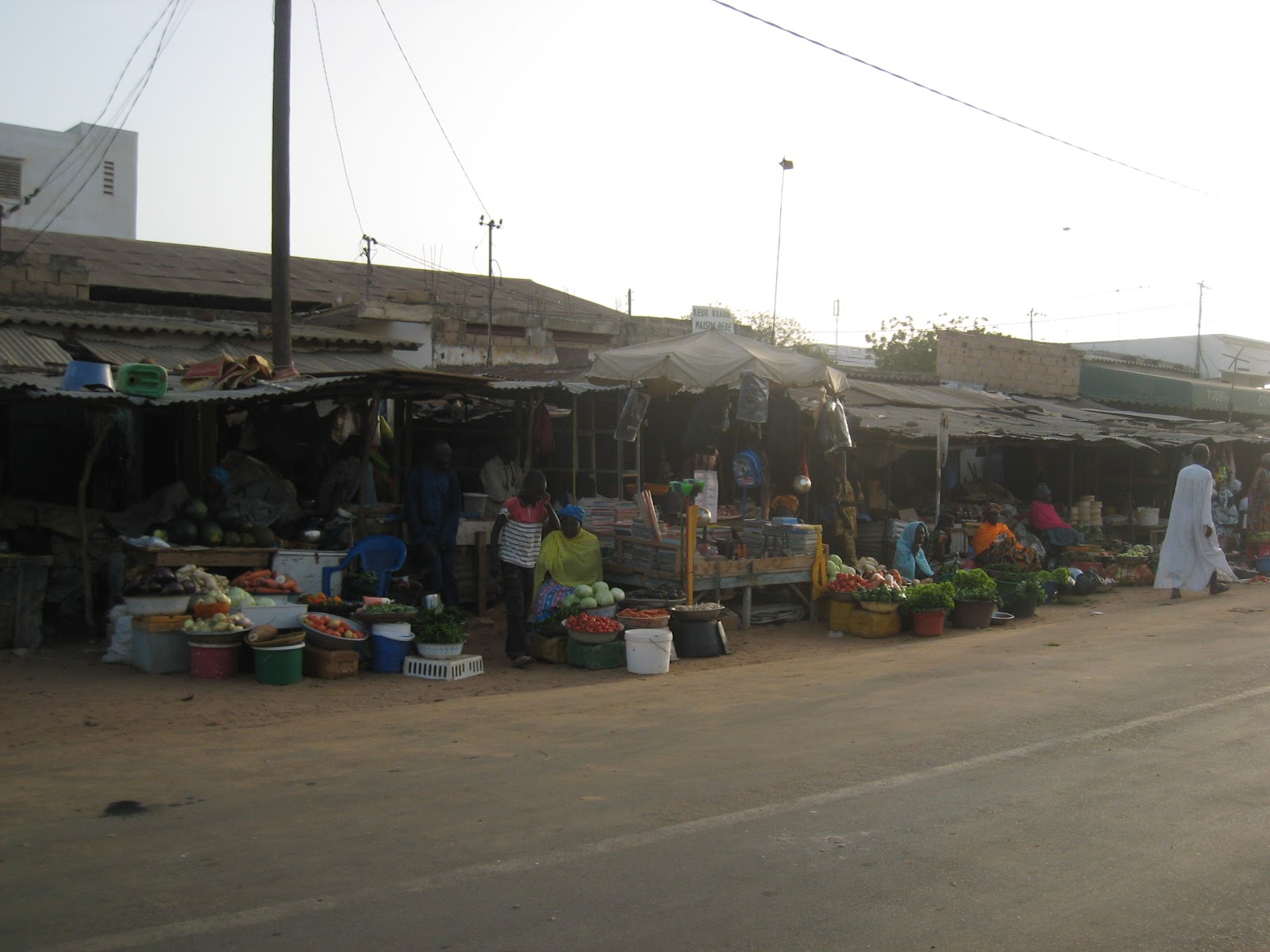
My village and my family are absolutely wonderful.  It’s a small village of about 200 people, but about 3 km from two larger towns where I can buy mangos, vegetables, and other items.  There is also a large weekly market about 5 km away in the Gambia where I can go to buy a larger variety of vegetables, plastics (they use imported plastic buckets, cups, etc. for everything), second hand clothes, fabric, cookingware, and pretty much anything else you can think of; the market is very well stocked.

In my family, I have a mother, a father who is village chief (more a title than anything else as far as I can tell though he does attend some meetings and collect payment from everyone), 2 younger brothers, and 3 younger sisters.  There are also 3 other families living in my compound and always other people in the village coming and going.  I absolutely adore all the kids in my compound.  The older ones – there are 2 girls and 1 boy in high school – are very helpful since they can speak some French and some English.  Some of the middle aged children – between 6 and 13 – are very patient with me, have learned to understand my accent and to teach  me new words, and I spend a good part of my day playing games with them and learning from them.  One girl in particular always makes my day because she loves to smile at me and is always happy.  And then there are the toddlers.  Only one will look at me or come near me, and I love her; the rest shirk away or scream at me when I get close to them because they're scared of me.  But with time, this safety bubble size has decreased, so I have high hopes for the future.  Also, there are all the adults who are wonderful.  At meals, they always encourage me to eat more, they're constantly trying to make conversation with me, my mom always checks that I have enough water (filled from a robinet-they charge a fee to use it, but I'm  not "allowed" to use the well yet), and my dad has hand-made me a stick bed for inside and a cement bed for outside.  of course, there's also the rest of the village who call to m e whenever they walk past my compound, always stop me to talk whenever I walk past them, cheer for me when I bike ride home, and invite me to eat a third lunch at their homes.  With all of this going on, I somehow find myself very busy doing not much at all - just sitting, watching, listening, and sometimes talking.  (Does that even sound like me?!)

There is always something interesting to see.  Horses walk up to my parents' hut door to wait for water, children race by playing with a hoop on a stick (think Colonial American game), toddlers pick up anything on the ground to play with, women carry buckets on their heads, people always visit everyone else, and lots more.  I have also learned a few new games, which interestingly are very similar to American games only they don't require fancy boards - just dirt and rocks.  No one was good at explaining them to me, so it's a good thing that I easily pick up on games.  There's one similar to checkers that I've become quite good at.   There's also one similar to tic-tac-toe, another to mancala, and another to jacks.  They get a kick out of watching me play them all.  I have also shown them how to play jacks, which they really enjoy and have crocheted a jump rope - which they already know how to use.  There's lots of children here to play all these games with, and they're a great way to improve my Wolof.

My Wolof is slowly improving.  I can understand more of what's said to me, though I am still laughed at for continuously asking people to repeat things to me so that I can understand what's said to me and try to remember it.  Also, though they are increasingly able to understand me, there have been some notable instances when they have no idea what I'm saying.  On my first night here, I was exhausted and wanted to go to bed early.  It took me 10 min of repeating this,  looking it up in my Wolof dictionary and notes to ensure I was saying the right word, and trying different pronunciations of the phrase to finally get the message through: Begge naa tella teddi.  3 weeks later, they still make fun of me for this (and I still go to bed early).  But at least we can all laugh together about everything.  It is quite comical (and I have a greater appreciation for ESL students in the US now-it's hard!).

Every day here seems so long because it's jam-packed with such a variety of activities.  I usually wake up around 6:30, though I don't emerge from my room until around 9 and spend this early morning time just taking some time to myself to exercise, journal, eat breakfast, and just think.  This is the only time I have really to myself all day.  Then I either sit outside with my family and the children all morning, greet other compounds in my village, go to a neighboring town for the market, or to the high school or health post in the neighboring towns.  My work hasn't really started yet.  Right now, my  most important job is to get to know people, adapt to village life, and gain the trust of my community.  Essentially, my job right now is to shmooze.

Sunday, June 3, 2012

Mailing Address

I finally have a permanent mailing address:


PCV Jackie Gerson
BP 23
Nioro du Rip
Senegal
West Africa


It's easier for to respond to snail mail than e-mail, so that is my preferred method!  Hope to hear from you all!

Monday, May 28, 2012

Bismillah

I finally installed in my village on May 16.  We spent all morning meeting officials in Kaolack, Nioro, and Medina Sabakh, and then finally pulled up in the Peace Corps van to my village around 3:30.  Children ran out to watch as the van drove into my compound.  I couldn't help but smile at everyone.  We arrived at my compound (good thing the driver knew which one it was because I couldn't remember) and there was a huge crowd there.  We were ushered from the car to the center of my compound.  Long benches were set up in a square around a table and some chairs (all under the large neem tree in the center of the compound).  There were more than 50 people there and more kept coming - mostly women and children.  I walked around and greeted all the adults on 3 sides, saying Asalaa Malekum and shaking hands.  Then I was told to take a seat.  My mother was very happy to see me and walked briskly over to greet me, Bismillah! (Welcome!)

I looked around at all the people facing me; I didn't know the faces yet, but I knew that I would get to know them all very well.  My female community counterpart had brought her folder from counterpart workshop with her and sat looking very official.  She looked much more comfortable here than she did in Thies (as I had expected that she would).  My  male counterpart then began to address the group.  He explained how I was here to help, how at first I would just be learning the language and culture, how everyone should welcome me, that they must help me or else I might work with the other villages instead, how they were excited to have me, and how I would assess their needs.  He did a great job of summarizing what he'd learned at the counterpart workshop.  Then my father welcomed me as part of the community.  He said that they'd wanted a volunteer for so long and were very happy to finally have one.  He hoped that I would be welcomed as family and even though I was living with him, he hoped everyone would include me as part of their families.  I was then asked to make a remark. This caught me completely off guard, as I hadn't been expecting to make a speech, but I thanked everyone for coming and said that I was very excited to be here.  They had to repeat what I said for everyone since my village couldn't understand my accent.  A few others spoke after me.  One man said how he'd seen other Peace Corps volunteers and the work they did and was excited to have me.  The head of the woman's group said that she would include me in everything and fight with the men over me.  She said they would help me learn everything about the culture, even washing my clothes for me.  (I wish!)  The whole ceremony was very touching and entertaining - official yet casual.  I enjoyed looking around at everyone and listening.  I saw everyone excited to see me, women wanting to speak, and children shy to know me, and I just imagined my 2 years here and how hard it will be to leave at the end.  I imagined all the relationships that I will form with these people, people who all want to know me, speak with me, and work with me.  People who are excited to help me learn Wolof and seem to understand Peace Corp's mission.  I am glad to be a part of this community.

After the speeches, everyone ushered me to the car to unload my things.  They all helped carry everything to my room.  Then the music started.  They banged bowls and containers and were dancing.  They pulled me in to dance.  I can't dance well, but I did anyway.  Some of the women danced to show off to me too. Gradually, people left the compound to go home and prepare dinner.  I was left with my wonderful family, and an eagerness to be engaged in the community.

Saturday, May 12, 2012

Duma estagere, Wolunteer laa!

As of yesterday, I am officially a Peace Corps Volunteer!  Duma estagere, wolunteer laa!  (I am not a trainee, I am a volunteer!)  We left Thies early in the morning to drive to the US Embassy in Dakar.  In the embassy, amidst speeches from Peace Corps staff, the US Ambassador, and one representative for each language from our training class, we were all promoted to full volunteers.  So our service has officially begun.  Following the ceremony, there was a small banquet full of American food treasures; we all devoured the pizza, beef kebobs, fritatas, cookies, cream puffs, and fruit tarts that were brought around for us to eat.  (We all crave cheese and dairy products here; yes, already.)

And tomorrow I leave for Kaolack!  Good bye training center!

 My training class
Me with my language teacher Aissatu

Tuesday, May 8, 2012

Jox ma xaalis yi

One of the major issues in Senegal revolves around talibe.  The word "talibe" literally means "student" and this word is used to describe the 150,000-200,000 children in Senegal sent from Senegal, the Gambia, Mauritania, Guinea, and Guinea-Bissau to study Koran under the tutorage of a maribout.  Generally, the come from small villages to live in cities.  They are supposed to be learning the Koran and about Islam and also about being humble.  Thus, they are sent to the streets to beg for food and money, so that they can learn to appreciate simplicity and not needing much.  Often in the streets, I am approached by young boys asking for money "Jox ma xaalis yi" ("Give me money") or by boys tapping my shoulder and holding out their bright yellow bowl.  Unfortunately, a lot of maribout are corrupt and don't teach the children; instead, they just use them to earn money, and the children don't eat much and aren't treated well.  Not much is currently being done to help the talibe, and Senegal is one of the worst countries in terms of human trafficking as a result.  I sat down with another trainee to interview one of our LCFs (language and cultural facilitators) about his experience as a talibe when he was a child.

At the time, he was upset that his parents were making him be a talibe, but in retrospect, he is very glad for the experience and even wants his children to be talibe.  He says it taught him to be friendly/social/outgoing, to not need much to be comfortable, and to get along well with others.  He is fortunate for what he has, but is ok sleeping on the ground or not showering everyday.  S. was 4 when he was first sent to be a talibe under his uncle.  His uncle was a well-known maribout with disciples coming from all over Senegal and neighboring countries to study with him in Thies.  (S.'s family lives in Thies, so he was luckily able to see his family, was familiar with the city, and knew the language; a lot of children do not have these "luxuries.")  Also, his uncle had sponshorship from abroad, so he didn't depend upon the money that the children got on the streets.  (Most children have to bring back a certain amount of money everyday, or else risk being beaten.)  Nevertheless, he (like the other talibe) had to beg for food and money for meals.  Every talibe was assigned a group and an older talibe to supervise them.  They begged together and then shared the food they received; they received a mix of bread, vegetables, uncooked rice, meal left-overs, etc.  At first, S. went to his family's house to collect this food, but then they told him that he had to go out and beg like the rest of the boys.

S. had a good talibe, so he was studying as well.  (Many talibe do not actually receive the Islamic tutelage they are promised.)  He would wake up, pray, beg for breakfast, study, beg for lunch, study, beg for dinner, and go to bed.  At first, he had to memorize the Koran (in Arabic).  He'd be given lines to memorize and recite (all within his group).  He still remembers a lot of this today and thinks that this early memorization training helped him learn fast in school (because he was accustomed to memorizing).  After he memorized the Koran, he began to learn the book of laws.  He stopped being a talibe before he could complete this.  (He was only a talibe from ages 7-11; some boys are talibes between ages 4-16.)  The next step would've been to interpret the Koran.  S. was also lucky because his uncle was kind.  However, his uncle also traveled a lot and was sometimes away for months at a time.  Then the older talibe were in charge, and they didn't always treat the younger ones well.  One time, S.'s cousin was beaten badly for not correctly reciting a verse.  S. went home and told his father, thinking that his father would be equally enraged; he wasn't and said that his cousin should've studied better.  S. is very fortunate that this beating only occurred when his uncle was gone; many other talibe are not as lucky.

After being a full talibe for a few years, S.'s older sisters asked their father to allow him to attend public school. They and his mother thought that he needed to learn other subjects, but his father wanted him to learn about Islam.  After some debate and more beggging on his sisters' part, his father acquiesced.  S. began to attend the public Koranic school (dara).  (In Senegal, there are public French and Arabic schools.)  However, on weekends and during holidays, he continued to be a talibe.  Sometimes he would even study Koran with his talibe group before school.  During school times, he lived at home and commuted to his uncle for the weekends, studying with the other children who commuted.  During vacations though, he lived with his uncle again.  Sometimes his classmates would be confused about his identity and would ask him if he was a student of a talibe (since they would see him begging).  Eventually, he stopped being a talibe and just went to school.  His younger brother was also a talibe, but he only commuted to his uncle and attended public school.

As I wrote above, S. is very grateful for the experience and learned a lot from it.  At the time, he did have a hard time understanding why his parents were putting him through this and was upset, but now he is glad for it.  (He is also glad that his sisters convinced his father to send him to public school because there is a lot to be gained from that system too.)  He plans to send his children to be talibe too, but he will have them commute and will ensure they have a good maribout.

S.'s story is one of the few positive talibe stories; most children are not as fortunate and do not have good maribout.  They arrive in the city, unused to the bustle of urban life, not knowing the language, having no friends and family, forced to live in a small room packed next to other children, generally are malnourished, often beaten, wear raggedy/old/large clothes with no shoes, and do not receive the Koranic training promised to them.  These children sometimes try to escape, though often they are brought back to their maribout.  Even if they did escape, their choices are few; they can try to find their way home to their village, but even if they make it, they do not have the skills to be successful in a rural area (nor are they prepared for rural life after living in an urban area for so long).  Thus, they find themselves in limbo, uncomfortable in villages and the city, without the skills to find a job in either place, and not much better off than before.  This is a serious problem that Senegal must deal with.

S. admits that there are many problems with this current talibe system.  He says that many maribout are corrupt, demand unreasonable amounts of money from their talibe, and beat them.  Often they don't even teach the children, and the boys just beg all day.  Also, with so many people begging on the streets (not all the children are talibe, some are just beggars), it is difficult for people to identify the talibe to support them (for the few who do give money or food to the talibe).  S. thus supports a program that his neighborhood takes part in, entitled "1 talibe, 1 home."  Through this program, families such as his support talibe.  They have the same talibe come every day and give him (or them) food for meals.  This way, the children are still learning to be humble, but are receiving adequate nutrition.  Programs such as this are very important.  The talibe system is so ingrained in culture and religion that it would be near impossible to overhaul it, and this would be the wrong strategy.  Instead, the merits of the system should be promoted and work should be done to make the system more just and endurable for the children.  This is the approach that should be taken (according to S.).  And I agree - the system does have its merits (learning the Koran, learning to be humble), but I am still appalled at how corrupt it has become.

Dinaa la namm

I just came back from my final day in Mboro.  We spent the final day traveling around the town, thanking everyone and saying our goodbyes.  We made two important stops - one at the healthpost and one at the school.  As usual, nothing works as planned at the healthpost, and none of the healthworkers were in, so we sent our farewells with others.  At the school, we gave special thanks to the students because the garden looks amazing.  I can't believe how much is growing; it's nice to see that plants can grow in the sandy soil and also that the students are taking such good care of the garden.  It's also amazing to see how comfortable I've gotten in Mboro.  I can navigate through all the streets and greet people on my way.

It was sad to say goodbye to my family, but hopefully I'll be able to stop back in Mboro to see them again.  Dinaa la namm.  (I will miss you.)

 My family in Mboro in our compound
 Our garden at the school
The market in Mboro


And now I am back in the training center for my final week of training.  Tomorrow, I have my final language exam, then Thursday my host mother from Mboro will come to Thies for a final farewell party, on Friday I officially become a Peace Corps volunteer, on Sunday I move all my stuff to Kaolack, and on Wednesday I move into my new home!